Blog

From Orchestration to Optimisation:
How Airlines Can Turn Payments Into a P&L Growth Lever

Cover JUNE Pillar Article From Orchestration to Optimisation

Planes may run on jet fuel, but as a business, modern airlines are powered by payments.

Airlines have for some time embraced an e-commerce model for ticket sales, extra services, and ancillary products – and today, digital payments are now essential to their business model. Indeed, according to a recent study from ResearchGate, 67.7% of all airline booking activities are now conducted online.

Further, data provided by the International Air Transport Association (IATA) shows that the airline industry now processes an estimated 2 billion transactions through their digital and internal systems every year. The same IATA report claims that this payment activity annually accounts for nearly $1 trillion in payment value.

So, the big question is this: how can airlines turn payments from a drain on revenue, into a growth lever?
The Role of Payment Optimisation


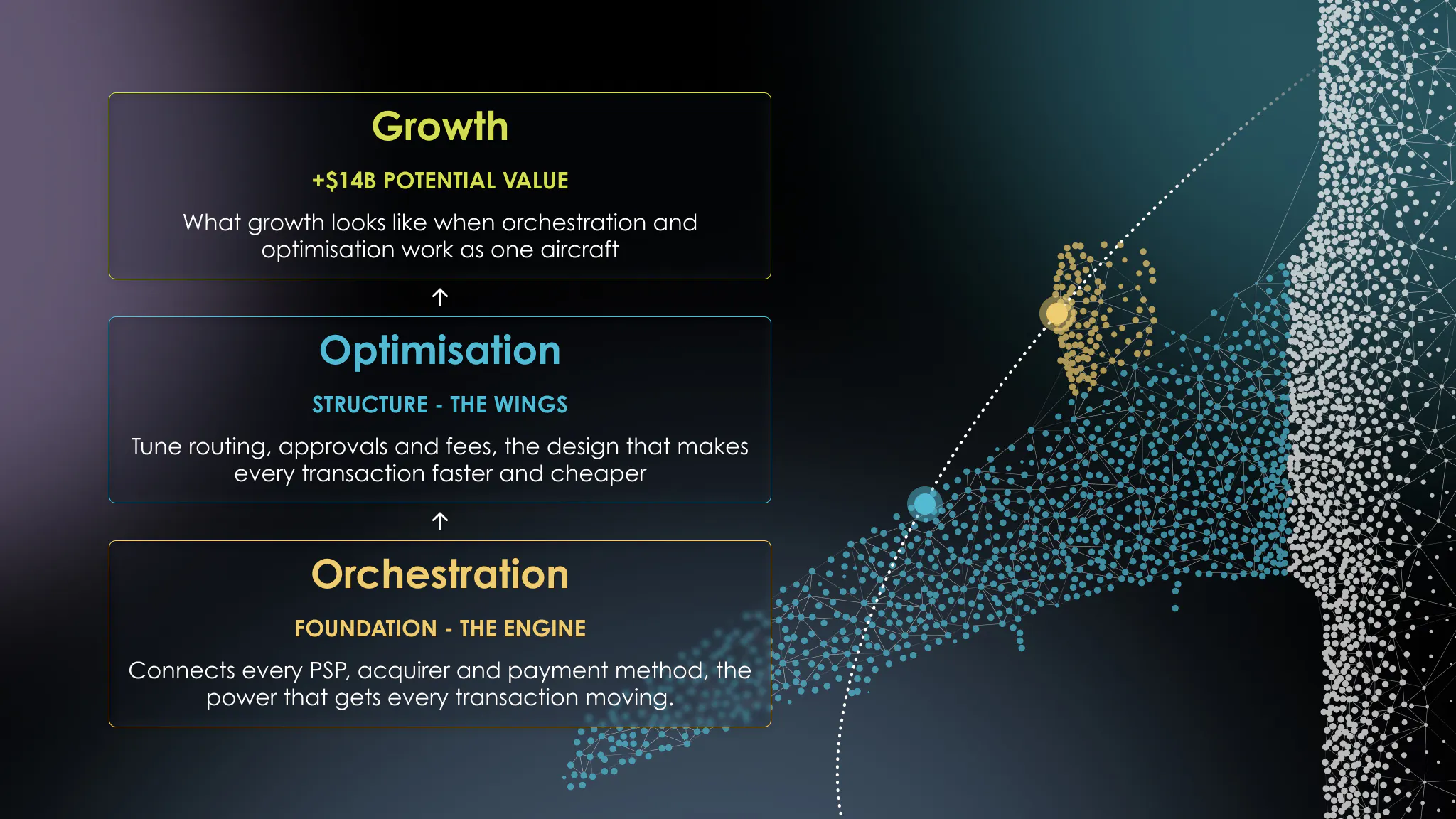
For many years, the travel industry’s biggest priority was to use payment orchestration advanced, future-proofed payment infrastructures that could handle the volume and complexity of such transactions in a modern marketplace.

Now, savvy airlines are focusing more on optimising and improving the speed and quality of their payment systems. The end goal of payment optimisation is to change payments into an essential growth lever for revenue and cost saving in an age of financial insecurity and geopolitical instability.

Payment optimisation delivers revenue opportunities and cost savings for airlines through several key strategies:

  • Reducing Cart Abandonment: Streamlining the payment process by ensuring that dynamic, risk-based authentication helps more customers complete transactions and reduce failed transactions.
  • Intelligent Routing: Ensuring that each payment takes the most efficient path to validation.
  • Alternative Payment Methods (APMs): Supporting regional preferences to capture wider audience demographics.
  • Cutting Processing Fees: Optimizing routing bypasses high cross-border fees and reduces the rate of expensive false-declines.
  • Airport Upgrades: Upgrading physical point-of-sale systems encourages spontaneous purchases like upgrades and other products.
  • Tokenization: Securely saving preferred customer payment methods enables them to easily make one-click secure purchases, which increases spending.
  • Smart Settlement: Carriers to balance transaction volumes across multiple acquirers, optimizing settlement cycles and reducing risk concentration.

But before we explore these strategies in greater detail, let’s first examine the kind of issues which are eating into airline profits and draining resources.

Airline Revenue Challenges

Airline Revenue Challenges


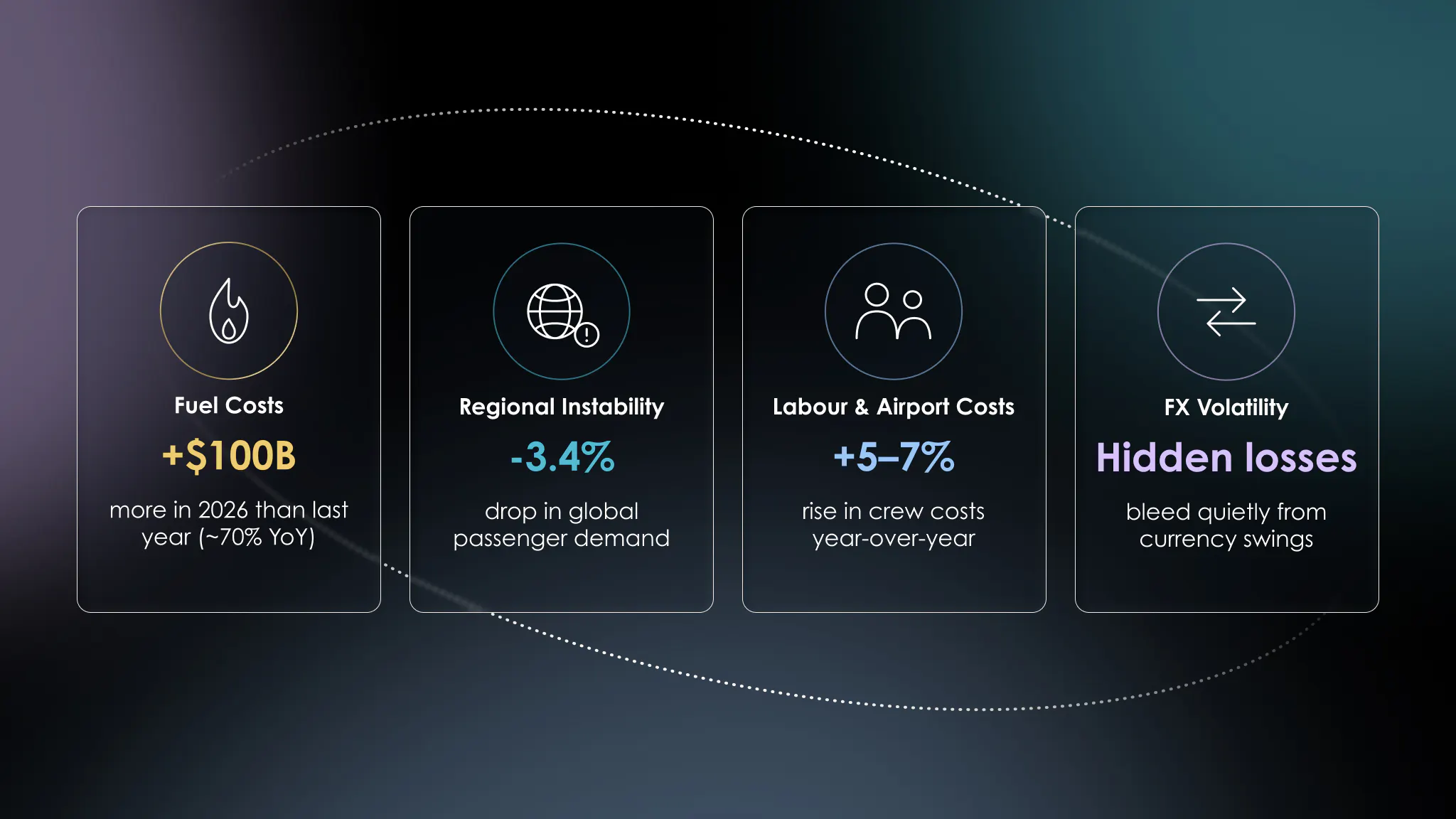
2026 has been a financially challenging period to date for the majority of commercial airlines – from traditional and established brands to ultra-low-cost carriers (ULCCs).

Despite record-breaking global airline profits overall, razor-thin margins have forced smaller regional and low-cost carriers into bankruptcy, after succumbing to unsustainable operating costs, supplier charges, and liquidity challenges. Some of the main financial challenges airlines include:

  1. Fuel costs
    Supply chain issues provoked by the recent conflict in Iran caused jet fuel prices to soar. Per Forbes, airlines will collectively pay $100 billion more for jet fuel in 2026 than last year, with the precious resource costing around 70% more, year-over-year. While airlines themselves have borne the brunt of these costs material, this has also had an impact on ticket prices, which has discouraged many potential customers from travelling.

  2. Regional instability
    Secondly, global conflicts in regions such as the middle east, Ukraine, and elsewhere have negatively affected airline routes, while economic and diplomatic sanctions upon certain nations have also impeded aviation. This, in turn, has made competition for the available routes more fierce, while limiting the journeys that airlines can offer consumers. Per the IATA, conflict in the Middle East alone has dragged overall global demand for carriers down -3.4% this year.

  3. Labour and airport costs
    The on-going cost-of-living crisis has also had an impact upon the cost of labour, as well as the costs associated with using airports. According to a report from BCG, average airline crew costs rose by 5% to 7% last year, following major contract renewals across Europe and North America. Meanwhile, ground-handling costs increased by 4% to 7% YoY after airports and third-party providers passed through wage and inflation adjustments.

  4. Foreign exchange volatility
    Finally, economic fluctuations around the world have also affected the exchange rates for currencies. For airlines, which depend on a constant stream of payments made from a wide variety of locations in many different currencies, this volatility can lead to large amounts of revenue lost through bad exchange rates.

As a result of all this, airlines have been forced to do more with less, while tightening control over their finances in a bid to recoup lost capital.

The New Paradigm for Airlines


Many airlines are restricted in how much they can update their payment systems, or are struggling to reap the real benefits. Their main priority is reducing short-term costs and increasing their short-term profits.

But by shifting KPIs of airline payments from purely operational uptime and cost mitigation to revenue generation and margin optimisation, airlines can leverage their payment systems to drive more revenue. Per a recent McKinsey report, airlines could potentially accrue an extra $14 billion in value (on top of their current takings by strategically improving their payments.

A payment optimisation strategy improves the payment experience for airlines and their customers, which makes these airlines far more attractive to potential sales leads. This increases revenue by helping airlines convert new customers.

Diagram of orchistration optimisation

The Hidden Revenue Payment Optimisation Can Access


Here are some of the key areas where payment optimisation can help airlines tap into hidden revenue:

  1. Approval Rates
    According to data provided by Zippia, over 88.87% of airline ticket purchases are left abandoned at checkout. Thus, payment optimisation works to improve approval rates for travel payments by reducing false declines and streamlining communication between airlines, payment gateways, card issuers, banks, and processors. By adopting tokenisation, strong customer authentication, and automated account updaters, airlines can ensure that less payments fail and more customers complete their purchases. This will, in turn, lead to greater sales and revenue.

  2. Smart Routing Decisions
    Smart routing is an automated system embedded into a payment infrastructure that evaluates real-time payment data, such as customer card types, banking information, currency, issuing country, and transaction size.
    After assimilating this information, the algorithm will quickly and efficiently choose the best payment method, acquirers, and processors to successfully and speedily complete the transaction. In doing so, it can help airlines circumvent pricey foreign exchange rates, processor fees, or volatility caused by geographic economic volatility.

  3. Fraud Reduction
    According to another white paper courtesy of the IATA, airlines lose an estimated $1.4 billion every year to online payment and booking fraud – accounting for approximately 1.2-1.5% of all online and mobile sales revenue.
    But payment optimisation aims to remove redundant steps in the payment process, while also boosting security measures. All this serves to decrease money lost through fraud or other forms of cybercrime.

  4. Ancillary Payments
    Payment optimisation also serves to improve not just payments for flight bookings, but also every form of payment across the entire customer lifecycle. These might include in-flight purchases, upgrades or special services, additional baggage allowance, extra transport to and from airports, or even accommodation upon landings. Indeed, McKinsey research claims that airline ancillary retail payments could unlock $45 billion in potential new revenue for the industry by 2030.

  5. Application Performance Monitoring
    Application performance monitoring is another aspect of payment optimisation, in which airlines deploy tools to continuously monitor, trace, and streamline the speed, reliability, and error rates of digital payment transactions. Per another report by Edgar & Dunn, only 80-85% of airline transactions are processed successfully. Yet, top carriers using dynamic transactions typically achieve rates of over 90%.

In a world of increasing uncertainty, where war, economic recession, and climate change have all combined to harm business and travel, optimising payments is the most sensible way for airlines to increase their revenue streams while reducing their costs and overhead. By doing so, they’ll be able to weather whatever crises await the industry down the lines, while less-refined competitors will be left to fall by the wayside.

CellPoint: Your Go To Partner for Payment Performance


CellPoint is the leading partner for any airline looking to improve their payments and recoup lost revenue. Boasting a wealth of experience in the travel and airline space, our team is on hand to provide support, guidance, and performance analysis for all your payments.

Plus, our payment orchestration platform is designed to integrate seamlessly with your existing core system, while our advisors can help your airline identify new optimisation opportunities.

So, are you interested in leveling up your payments? Then contact us to see how we can help.